Improving support in academic departments for autistic students

Online seminar – 29th January 2025

Join us online for a discussion of how academic departments can better support autistic students. Our panel of experts will share insights, best practices, and resources to enhance the educational experience for these students. Whether you’re a faculty member, professional services staff, or simply interested in the topic, this event is for you. Let’s work together to create a more inclusive and supportive academic environment!

The number of autistic students in higher education in the UK has increased by more than 300% since 2014. However, support for these students is not consistently distributed or implemented.  Autistic students frequently report anxiety and depression and a sense of isolation particularly at key transition points. At the same time, they ask for more joined up academic and social support as well as more awareness and understanding amongst academic staff.  

This workshop brings together a range of leading experts in UK academia who are developing innovative approaches to supporting autistic students within teaching, learning and assessment spaces, in order to improve provision at the chalkface.

Go to our event page to see the full agenda or book at our Eventbrite booking page.

UK Higher Education: Disabled Students Statistics

If you want to know the numbers of students who have declared a disability who are enrolled on courses of higher education in the UK you have to look at statistics provided by the Higher Education Statistics Agency (generally known by the acronym HESA (Hee-sah)). HEPs submit these figures to HESA each year as part of statistical returns at key points in the academic year. It’s not easy finding this data on the HESA website as the tables can be accessed through a number of routes so I’ve done it for you.

How do we find out how many disabled students there are?

You can jump directly to the disability statistics by jumping straight into the Personal Characteristics section. OR you can go through the Open Data section . Once you are in the Open Data section, access the Students section then look in the Who’s studying in HE? Followed by Personal Characteristics.

You can play around with various menus on this webpage but at the top level the data tells us that there are 484,270 students who have declared a disability and have given permission for this data to be shared. This represents 16.5% of all HE students (N=2,937,155) who are on all years of study and at all levels (including postgraduate students i.e. PhD/EdD etc). This has jumped up from 13.9% in the space of the 5 years covered. Unfortunately, HESA has only given the data for the last 5 years (2018/19 up to 2022/23) on this webpage, but you can get the data for a longer period of time from the HESA publications archive.

Problems with the data

Beyond the 2018/19

Here is where it starts to get tricky! (Well, you might say it’s been tricky already but…). If you want to go further back than the pages/data discussed so far you must start delving deeper into the HESA website which is no mean feat. To make it easier for you; to find equivalent data/tables going back to the 2016/17 academic year you need to access the ‘Figure 5 – HE student enrolments by personal characteristics 2016/17 to 2020/21’ page (a catchy name!) and also, the data doesn’t match!!! Before that date you have to download the raw data from the publications archive and start to collate some of the information yourself (which I will do in a follow blogpost).

Entrants vs enrolments

Some of the data/tables on the HESA website refer to new entrants (i.e. they are classed as being on their first year of their programme for the academic year referred to – this includes all master’s student for instance added together with first year undergraduates etc. It does not include 2nd year or 3rd year students or postgraduate research students who have completed more than one year of study). However, some of the tables do refer to ALL students (i.e. all years of study): so be aware that this is the case when using the statistics or comparing with your institution.

Rounding issues

For ethical reasons, so that individuals cannot be identified, the figures are rounded up or down to 5 or 0, so they are not absolute.

Disclosure issues

These statistics are based on numbers of students disclosing a disability. Most HEPs in the UK follow the definition of disability enshrined in the Equality Act (2010) (UK legislation) and there will be students who are unable to provide evidence that would define them as disabled under the Act. However, this doesn’t mean that this declaration would be removed from the statistics necessarily.

In a similar vein, as the figures are disclosures to the university there will also be a number of students who are disabled but who do not appear in the statistics because they choose not to disclose or don’t realise that they are disabled when they apply or enrol at their institution. Equally, there may be an issue with false positives (student who misunderstand the question (a small %) or tick it by mistake (an even smaller %).

Usually the number of students declaring a disability increases over the course of the academic year as students realise they might benefit from disclosing, come forward because they might be struggling (as is often the case with students with an undiagnosed SpLD), develop a condition (such as mental health difficulties), or just come forward because they didn’t want to disclose upon application for fear of discrimination.

Relatedly, the data is based on disclosures at key points during the student lifecycle which means that a lot of this data ‘rolls down’ from when the student applied to the institution for instance. Different HEPs have different ways of ensuring the integrity of this data and therefore there will be difference in the accuracy of this data. For example, some HEPs allow students to update their record and to remove this data.

Changes in categorisation

Categories of disability collected by HEPs and collected by HESA have been known to change down the years, so it isn’t that easy to compare across all available data with complete accuracy.

Embedding wellbeing into the curriculum

The International Network of Inclusive Practice would like to invite you to our next event bringing together academics, researchers, students, learning developers , disability and student support professionals.

This event is focussing on ‘Embedding well-being into the curriculum’ and will include opportunities to hear from academics, including Kate Lister from the Open University, Professor Richard Waites from the University of York and students and university professional support colleagues about their progress and challenges to date in implementing inclusive wellbeing practice in teaching and learning.

Kate will be sharing her perspectives on successful strategies for embedding mental wellbeing into the curriculum whilst Richard will give an overview of recent work on engaging with students about wellbeing issues. Additionally, there will be discussions on implementing the whole university approach as envisaged in the University Mental Health Charter, a student view of the importance of wellbeing which moves beyond the use of support services in teaching and learning spaces.

As with our previous event we will be holding this 2-hour session on Remo enabling networking as well as presentations.

If you want to book a ticket please do so through our Eventbrite page:

Embedding well-being into the curriculum Tickets, Wed 24 Mar 2021 at 14:00 | Eventbrite

Universal Design for Learning: Delivering Inclusive Teaching

Inside Government training course online delivery: 9th & 10th February

I’ll be delivering this course with my colleague Professor Nicki Martin.

The Universal Design for Learning Training Course will offer comprehensive support and interactive guidance on how universities can create, implement and deliver an inclusive approach to the learning experience to support improved student engagement and reduce barriers to learning for disadvantaged and disabled students.

Through expert training, the course will offer interactive discussion and solution focussed workshops to allow participants to develop their own strategy on embedding Universal Design for Learning (UDL) within their course development, teaching practices and assessment delivery.

The course will offer practical takeaways on pedagogy for course leaders and will deliver tips and guidance on how the learning experience can be transformed within your institution. The course will also explore how inclusive learning practices can evolve to meet the challenges of the Covid-19 crisis and the shift to virtual and blended learning.

Learning Objectives

  • Gain an understanding of the core principles of Universal Design for Learning (UDL) and how it can be embedded within your department or institution
  • Create your strategy for designing an inclusive curriculum and course content which meets the needs of all students
  • Learn how to adapt your teaching delivery to support inclusivity in the learning experience
  • Develop your approach to inclusive assessment and student expression
  • Evaluate how inclusive learning can be delivered to meet the demands of the virtual environment and blended learning in the Covid-19 era

International Network of Inclusive Practice virtual conference 2021 – invitation to submit a proposal

Inclusive teaching and learning in higher education: theory and practice
21st – 25th June 2021

Co-hosted with the Cambridge Centre for Teaching and Learning and the Disability Resource Centre, University of Cambridge

As higher education strives to close the gap on student outcomes for groups of marginalised learners our conference aims to discuss how institutions can provide coherent approaches to increasing diversity in the classroom. On the face of it, university campuses appear to adhere to traditional delivery models which are aimed at a one size fits all idea of teaching and learning. However, such approaches often rely on individualised models of student support and expectations that adjustments to teaching are negotiated settlements between disabled students and academic staff. Approaches such as universal design for learning offer a way forward in which institutional barriers in learning contexts are removed from the provider side of the equation.

The International Network of Inclusive Practice invites you to submit a proposal to present at the conference. There are three session formats:

Workshops: 75 minutes – workshops should explore a research or practice-informed topic and are designed with high levels of interaction in mind.

Discussion papers: 30 minutes – presentation of project findings, examples of practice, theory into practice from within your institutional or broader context, including no more than 20 minutes presentation and at least 10 minutes of questions and discussion.

Reading group: 45 minutes – propose a paper/book/blog/report that you wish to discuss in a reading group forum. Proposers will provide an overview of the paper followed by facilitation of the group discussion relating to lessons learned from the reading, theoretical exploration, practical applications etc.

To submit a proposal please send us a completed abstract template by midnight on Friday 12th February 2021. The conference will be free of charge for up to 2 workshop presenters.

Please be aware that all sessions should adhere to inclusivity principles and will be delivered online. You should consider the implications of this when developing your proposal and when designing your session.

Please return your proposal to mike@inclusioninhe.com 


Session proposals might expand on ideas such as:

  • How do theoretical models such as universal design for learning and the social model of disability translate into classroom settings?
  • What are the challenges for approaches such as UDL? Can we assume that the need for individual adjustments is removed for example? Are external pressures such as the neo-liberalisation of higher education intractable problems when applying such models?
  • Practical examples of inclusive teaching and learning and how these can be applied to other institutional settings
  • Cross institutional approaches which utilise theoretical underpinnings to develop practice
  • Scholarship of teaching and learning: approaches to supporting disabled students in the classroom
  • What lessons can be learned from inclusive approaches to teaching and learning applied during the global pandemic?

How not to give a presentation

This one goes out to all those who are introverts, HSP, shy, or just don’t relish the thought of giving presentations (nearly everyone at some point – right?). This scene from a Melissa McCarthy return to college film about a mature learner (mum), had me in stitches: literally falling off the sofa. We’ve all been there!

e-Seminar on Inclusive Practice in Online/Remote Learning

The latest event organised by the International Network of Inclusive Practice will take place on Wednesday 4th November 2020, 2.30pm – 4.30pm. 

The Covid-19 crisis of 2020 created an unprecedented challenge for higher education providers as they moved entire faculty curricula online whilst attempting to maintain an equitable experience for students from across the globe. Some of the solutions to these challenges closely resembled approaches which had previously been suggested as removing barriers which exist for disabled students.

This online seminar asks if this punctuated equilibrium marks a turning point for an accelerated move towards inclusive approaches in HE or, has the sector’s response created more problems than it answered for marginalised groups of students?

Facilitated by Pete Quinn & Mike Wray and hosted using the Remo platform we will hear from speakers in 4 UK universities and welcome delegates to:

  • reflect on your practice, 
  • hear both teaching and learner experiences 
  • discuss and decide on inclusive ways forward

Please visit http://www.inip.org.uk/events/inclusive-practice-in-online-remote-learning/ for details of our presenters or book directly via Eventbrite at https://www.eventbrite.co.uk/e/inclusive-practice-in-onlineremote-learning-tickets-124092701611

What is universal design for learning in higher education?

Universal design for learning is receiving increased attention in higher education as an approach that could solve some of the attainment issues which face diverse groups of learners.

This approach to teaching originates from architecture and according to Rose et al (2006) ‘universal design involves designing products, buildings, or environments so they can be used readily by the widest possible range of users.’ Applying this to higher education takes us to a definition along the lines of – universal design for learning in higher education involves designing lectures, modules, courses and higher education institutions so that they can be accessed readily by the widest possible range of students.

So what does this mean in practice? A good place to start are the guidelines which have been developed by CAST an organisation which has been at the forefront of the development of UDL.   These guidelines suggest three underpinning aspects of delivery which programme designers should consider from the outset in order to improve the inclusivity of their courses and modules.

Lecturers should consider how they:

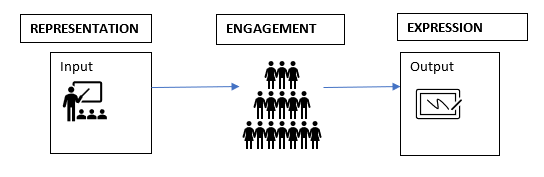
Provide multiple means of representation – the what of learning;

Provide multiple means of engagement – the why of learning;

Provide multiple means of action and expression – the how of learning.

The best way I can think of simplifying this framework is to think in terms of an input/output model.

The input is the how the content (or the information) of the course is delivered. The students are the people in the middle, (who all come with their own different backgrounds, resources, strengths and weaknesses), the recipients of the information receiving this input, and the output is how the student is going to demonstrate and utilise the information. What do you want them to do with the knowledge they have acquired?

Rose et al (2006) in their seminal paper describe how they have applied the principles of UDL as they see them, to an undergraduate course. They updated this paper in 2015 in the book Universal design in higher education: Promising practices edited by Sheryl Burghstahler. I have used some of their examples to illustrate what the three aspects refer to in terms of delivery.

Representation:

This aspect isn’t primarily about what the curriculum is going to contain but rather, how are you going to allow for different ways of accessing the curriculum? How are you going to present the information so that it can be accessed by a diverse range of learners as possible. Rose et al (2006) discuss a range of ways in which they do this. For example, they video each lecture and make it available on a website, they collected notes from students and posted these on the VLE so that other students could see different ways of understanding what was relayed (but also as an informal way to check for understanding). This also had the additional advantage of reducing the need for note takers to be supplied by central disability services. They emphasise the use of Powerpoint to provide structure rather than as a textual alternative to what is being said and they place an emphasis on the use of visual elements to act as supplements to the verbal content.   

Engagement:

For me this element is essentially about the student, but importantly how do we motivate them to engage with the information that is presented throughout the course. The student body is increasingly diverse and have a broad range of motivations and socio-cultural resources. It is imperative that we design learning opportunities that allow for this broad range of difference so that we get the best of them. Rose et al (2006) say that this element of UDL was met through the range of choice which was offered. Students were able to access information through a range of media, could access different types of discussion groups, had choice of what to read etc. Therefore, students were given opportunities to engage in the ways that they preferred and which they found motivating.

Expression:

What do we want our students to do with the information we present and how do we want them to demonstrate to us that they have understood what was presented? More often than not this aspect of UDL is taken to mean assessment. Of course, assessment can be formative as well as summative and teachers can assess how well students are understanding content through course delivery: asking questions as they go along, encouraging discussion etc. Rose et al (2006) moved away from traditional forms of assessment by giving students a literature review project which required them to display their findings through a website (limited to 1500 words and displayed publicly for other students to see) followed by a lesson plan based on the literature review. In this way they say that the variety of skills required allows for the varied strengths of the students to be assessed.

Burghstahler, S. E. (2013). Universal design in higher education: Promising practices. Seattle: DO-IT, University of Washington.

Rose, D. H., Harbour, W. S., Johnston, C. S., Daley, S. G., & Abarbanell, L. (2006). Universal design for learning in postsecondary education: reflections on principles and their application. Journal of Postsecondary Education and Disability, 19(2), 135 – 151.

Beyond ‘Beyond the bare minimum’

A recent briefing ‘Moving beyond the bare minimum’ published by the Office for Students (OfS), asks whether universities and colleges in the UK are doing enough to support disabled students. The title of the briefing is perhaps somewhat unfortunate since, as the author points out, considerable progress has already been made in the last 20+ years in terms of improving access and one might be forgiven for thinking that the briefing could utilise a more accurate baseline with which to stretch the sector than the ‘bare minimum’. Here are a set of alternative observations based on the recommendations and arguments within the briefing, which are aimed at moving us ‘beyond the quite significant efforts’ that most institutions have already made:

  • Most HEP corporate strategies envisage inclusive institutions, with senior management committed to inclusive practice and culture. However, the briefing does not give a clear vision for where the sector should be at this point in time (25 years on since the Disability Discrimination Act 1995 was implemented and nearly 20 years since HE in the UK was fully incorporated into that legislation). One way of evaluating this is to survey HEPs against the base level-document which was commissioned 20 years ago (failing that, use one of the previous Quality Assurance Agency’s code of practice). Instead of analysing access statements into which disability offices and disabled students often have very little input, the OfS should make it a requirement that, in the first instance, HEPs ensure they have ‘base-level’ suggestions in place.
  • The briefing argues for more institution-wide schemes such as widespread use of recording of large lectures. Many larger and more established HEPs have made significant strides in this direction (albeit not with disability equality primarily in mind). However, projects such as this often require a significant injection of funding. The OfS could provide targeted funding for projects, outlining a range of areas which could be funded (so that HEPs who are ahead of the curve on this adjustment to practice don’t miss out). This could be considered when the OfS reviews the use of the £40M funding (Annex A at the bottom of this webpage) which they allocate to HEPs which is supposed to be aimed at disability specific provision. What usually happens is that the £40M allocated funding gets amalgamated into existing budgets (often the existing spending is far higher than the OfS allocation) and there is little incentive or ability to commit large additional pots of funding.
  • Organisations such as the OfS need to move beyond the bare minimum in terms of social model thinking.  Recent policy documents, including this OfS briefing, use the rhetoric of the social model of disability (particularly since changes were made to DSAs funding) but there has been very little movement beyond the bare minimum in terms of governance and policy instruments. We see this reflected in the briefing in the statistics which are presented, which are all based on medical impairment categories. I’m not convinced that a step forward is to ask HESA to split the ‘multiple disabilities’ (sic) category into its constituent parts. Anyone who has worked in disability services will tell you of the number of times when they’ve been asked by staff to give them a further breakdown of students’ impairments beyond the top line category.  For example, when I first worked in HE academic staff wanted to know what each medical condition was and how it affected the individual’s learning – but why does a more in depth medical description of ‘von Willebrand disease’ for example, assist in delivering inclusive teaching and learning? More recently people have asked for breakdowns of specific learning difficulties category, and very recently, breakdowns of mental health difficulties disclosures. Again, the question is how does this assist in delivering inclusive teaching and learning? If we really want to move forward with understanding what HEPs are doing in terms of breaking down barriers we need to start gathering evidence on what adjustments are being made. We should be asking more social model related questions of providers such as how many people get extra time in examinations in each HEP?  What percentage of lectures are recorded and put online? How much of the estates budget has been utilised to make buildings accessible in each HEP? The OfS should ask HEPs to start counting adjustments that they make to improve access (for example the numbers of examination alterations such as extra time) alongside the requirements to count student impairments. Best practice – the Open University support statistics on summer school adjustments.
  • Non-continuation rates should be explored in more depth – without talking to people who have dropped out it is difficult to extrapolate what the reasons for the differential rates are. There will, no doubt, be a complex interplay between barriers in the environment and individual differences in the circumstances of the student. As the briefing points out some groups of disabled students do better than others. We therefore need to understand better why this is the case by (as the briefing suggests) exploring the experience of individual students.  On a related point the briefing suggests that non-disclosure rates are an issue (but why is this an issue if the figures are at record levels and at record ratios?) We need to explore the story behind the data such as who’s not disclosing and why? Are people disclosing who aren’t disabled under the Equalities Act (DSA applications would suggest that this is the case since many get rejected because of a lack of medical evidence). We need to understand better and ensure that statistics are robust, before basing policy on them.
  • Self-disclosure, as any HE disability office worker will tell you, grows rapidly as the academic year progresses, not least because the HE sector is running to a different beat to the rest of the education sector. Therefore, the OfS should pressure the government to remove the unnecessary barrier of replacing Education Health and Care Plans (EHCPs) at HE level. In the briefing an example of good practice is given of a college which helps disabled learners with transition. This transition planning would be greatly assisted if the funding systems weren’t so different between the different levels of the education system and if EHCPs weren’t replaced by assessments of need. The briefing mentions that there is cross political party agreement on this. In an accompanying document  Piers Wilkinson points out disabled students face added burdens of arranging a number of additional matters, such as in-class support, when they get into higher education. This wouldn’t be as much of a burden if disabled students kept their EHCPs and if they didn’t have to negotiate a whole new and highly complex funding system when they enter HE.
  • The OfS should think twice before offering any more policy and pressure HEPs to implement existing policies– in my study of policy implementation in HE there were over 300 policies which staff were expected to follow (a policy epidemic as Levin pointed out in 1998).  We have had and continue to have, fit for purpose policy in this area; we had the QAA code of practice for 20 years; we’ve has the base level document around for nearly 30 years; and we’ve had the Equalities Act for nearly 25 years. Perhaps we can move beyond the bare minimum of much of the policy rhetoric and implement the policies which are already in existence?

Policy flaws in the UK HE system of support for disabled students

All policies are flawed as they are the result of political processes when they are created and are interpretable by staff at street level when actual implementation occurs. More often than not they reflect disagreements between different sides of the political establishment and are in part written with many stakeholders’ opinions in mind. Incrementalism is the usual result, as the ideas of politicians come to fruition within legislation: policies take shape over several years and through several iterations. Such is the case with policy within the UK HE sector around disabled learners – the result of several policy strands, developed over the last few decades, which together form the policy context.

At the moment, the discourse from within the Department for Education, as a result of fiscal tightening, is around how HEPs should move to more inclusive approaches. However, we didn’t get to this point in the policy process by starting with inclusive approaches in mind, so we are left with policy legacy which wasn’t intended for the current purposes. So here are some thoughts about how the current policies are flawed – they’re not intended as a definitive list, but rather as points for discussion and further contestation.

It relies on the Equality Act 2010 to drive practice

However, legislation such as the EA2010 in itself relies on individuals taking big organisations such as universities to court. Even with the support of quangos such as the EHRC few students are likely to want to go through the convoluted and possibly very expensive legal process this requires. Students don’t want to be at war with the university in an individual capacity as they believe it puts their degree classification on the line and are worried about retribution. Even when a student does take an HEI to court (and anecdotally this is increasing as students who are discriminated against seek financial compensation against high fees through litigation cases) the case is more often than not settled out of court since the institution does not want to be dragged through the press. This means that once battle lines are drawn the university becomes overly defensive as it seeks to mitigate any financial loss or admittance of wrong doing. HEPs would rather settle out of court and this leads to entrenched views rather than positive organisational changes. In worse-case scenarios it can lead to hidden resentment from staff.

No teeth to legislation

A corollary of the above is that most staff don’t take the threat of legal action seriously. Few people have been involved in a legal case or even heard of a colleague who has been dragged into one, so the legal ‘stick’ fails to provoke action. Whilst guidance from organisations such as the EHRC is more proactive and aligned with the social model of disability, which seeks to remove barriers to participation, it is fundamentally underpinned by a legislative/legal model.

Medical model definitions

The Equality Act 2010 relies on medical model definitions. The legislation defines disabled people in terms of their impairment. This can cause issues in legal cases since a significant number (particularly around employment) get thrown out of court because impairment can’t be proven. And it weakens discourse from organisations such as the EHRC when they allude to the social model of disability.

Medical model thinking

The HE sector relies on the medical model of disability. UCAS and HESA, who collect information on disabled students/applicants, use a system which is based on impairment categories. This weakens any discourse from organisations such as HEFCE (now OfS) when they suggest to HEPs that they should move towards inclusive teaching and learning based on social model arguments.

Funding is based on medical categorisation

Institutional funding relies on medical definitions of disability categorised as above. The OfS disburses monies based on disclosure against a list of impairments. However, funding bodies should move towards a funding model based on resource management. If HEPs are providing xx number of hours of note taking for disabled students, they should be recompensed for it.

Statistical information is patchy

OfS/HESA figures are flawed in several ways. They are only proxies of demand. For example, the numbers of students disclosing dyslexia (SpLD) is about 50% of the overall intake of disabled students but it is still rare for a student to possess a fully recognised education psychologist’s diagnosis for the SpLD when they enrol for HE study. Each year about 1/6th to ¼ of the those students who declare an SpLD are being re-assessed because their diagnosis is inaccurate. Similarly, about another 1/6th of these students are newly diagnosed i.e. didn’t know they had SpLD until they entered HE. There is no accurate understanding of how many of these disclosures are never validated through diagnosis. This is also increasingly the case with students who declare a mental health difficulty. No one has provided an accurate understanding of what these, rapidly rising, disclosures actually mean.

The funding model is based on an individualised/medical model/semi market (a mish mash approach)

Some monies go directly to the institution but there is very little monitoring of how these monies are used. The monies are not ringfenced, and never have been, but come through the main grant received as part of WP funds. This approach is more aligned to a social model of disability since the institution can, or at least should divert attention, resources and spending to remove barriers to access and to ensure that the HEP is inclusive. However, support is still largely funded through DSAs which are underpinned by an individualised and medical model approach.

Disjointed approach to defining how support should proceed

There is very little joined up strategy between the DSA process and the realities of street level implementation of teaching practice. Unlike the schools’ sector in which disability staff/teaching staff are part of the process of creating a report on learners’ support, the HE sector in the UK, relies on external staff who usually have not had any HE teaching experience, to write a report based on a limited number of recommendations. These reports are written in order to draw down funding from DSA and are very rarely, if ever, reviewed as the learner progresses through their studies. However, the reports are often circulated to teaching staff with the understanding that they implement the recommendations for adaptations to their teaching practice. HEPs then repeat similar exercises to produce learning support plans which are more context specific but which in turn, rarely involve academic staff who are left to implement recommendations without much input into their rationale.